Frequently asked questions: The ICRC's work in Iran

The International Committee of the Red Cross (ICRC) has been in Iran since 1977. We work in partnership with the Iranian Red Crescent Society (IRCS) and other Iranian organizations in the fields of promoting international humanitarian law, helping people reestablish contact with their relatives, physical rehabilitation and health care services.
For more information, we invite you to visit our page about our work in Iran.
-
The ICRC started its activities in Iran in 1977 and maintained its presence in the country during the 1980-1988 Iran-Iraq War. We expanded our activities in the country since 2001.
Today, we work in partnership with the Iranian Red Crescent Society and other Iranian organizations in the fields of physical rehabilitation, tracing missing persons and restoring family links and health care services. We continue to help address the humanitarian consequences of the 1980–88 Iraq-Iran war in relation to the issue of missing persons, and we promote international humanitarian law and humanitarian principles
We also support access to health care & physical rehabilitation for Afghan migrants and vulnerable local communities in Iran in cooperation with the Iranian Red Crescent Society and local non-government organizations.
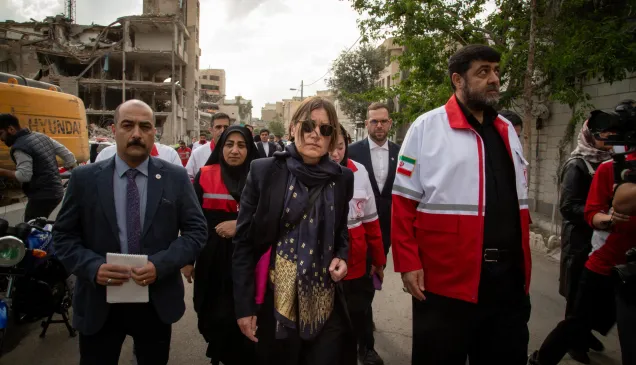
Since the recent escalation of hostilities between Israel, the United States of America and Iran, we have been engaging with relevant authorities and our partner, the Iranian Red Crescent Society, to scale up our humanitarian response to address the needs of people affected by the conflict.
-
The ICRC is not in a position to support the evacuation of individuals or groups out of Iran. We do not have the capacity to support movements of populations within Iran or to the borders nor across the borders. We are also unable to indicate areas that could be deemed safe.
We acknowledge the fear and uncertainty you may be experiencing and regret that we cannot offer a different answer.
-
Restoring Family Links (RFL) services are provided in all provinces of Iran through the Tracing Services of the Iranian Red Crescent Society (IRCS) which is the main RFL provider in the country. The ICRC in Tehran works jointly with the IRCS and provides its technical support for the treatment of RFL cases.
If you are inside Iran, you can contact the Iranian Red Crescent Society through the following means:
By phone:
+982185632447
+982185632442
+982185632431
+982185632432
By Fax:
+98 2188201052
By email: int_tracingrfl@rcs.ir
OR by visiting the nearest Iranian Red Crescent Society branch to where you live.
The address of their office in Tehran is:
Iranian Red Crescent Society
Under Secretary General (USG)
International Affairs & IHL
No. 2654 Valiasr Ave.
Building of Peace, Tehran, IranIf you have lost contact due to lack of connectivity, we recommend that you first wait a few days and approach the Iranian Red Crescent Society, once the telecommunications are restored, if you still cannot reach your loved one.
If you are outside Iran, please contact the nearest Red Cross or Red Crescent office in the country where you currently live. You can find more contact information in this directory.
We acknowledge the distress of having a missing relative, and we hope this painful and distressing period is over soon for you and your family.
-
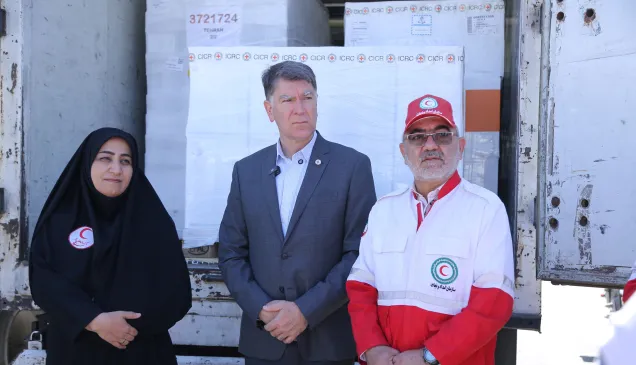
Our partner, the Iranian Red Crescent Society, has been responding to the immediate humanitarian needs of people affected by the conflict. We continue to coordinate closely with them to support their humanitarian response.
-
We have a long-established partnership with the Iranian Red Crescent Society that dates back to when the ICRC first began working in Iran.
Despite safety and security challenges, Iranian Red Crescent Society staff and volunteers continue to provide lifesaving humanitarian services and do all they can to help civilians in an extremely volatile security environment, despite huge personal risks.
For many years, the ICRC has provided technical and material support to the Iranian Red Crescent Society to help strengthen its humanitarian response capacity.
The ICRC also works with two local non-government organizations to provide a range of health and physical rehabilitation services to vulnerable Afghan migrants and local communities in Khorasan Razavi and Sistan and Baluchestan provinces.
-
The ICRC currently has no humanitarian activity in prisons or other detention facilities in Iran, nor does it have the possibility to directly confirm detention or pass family news.
-
Yes. We actively speak out about the humanitarian consequences of armed conflicts. Our principles of neutrality and impartiality are not always understood – especially in emotionally charged situations – but these principles are the core of our work and aren’t about staying silent. They are essential to our work as they enable us to build trust with all parties, reach people in need where we have operations, and operate in complex environments, to ensure that our humanitarian services can reach those who need it most. Our humanitarian principles are critical to our ability to operate in any context.
We continue our efforts to inform people, including parties to the conflict, about what the ICRC can and cannot do based on our mandate and principles.
-
The ICRC is not a political organization and has no power to stop wars. Our role is to help people affected by conflict and remind all sides to respect the rules of war and protect civilians.
-
No. We operate without religious affiliation. We are a neutral, impartial and independent humanitarian organization and we work with impartiality as to nationality, race, gender, religious beliefs, class and political opinions.
Under international humanitarian law, all those caught up in war, no matter their affiliation, should be protected.
-
Our preferred way of working is through bilateral and confidential dialogue with the parties to an armed conflict. A confidential approach allows us to talk candidly and openly with the belligerents and to try to influence their behaviour. Although we may not make strong public statements, we do not refrain from having tough conversations with belligerents on respect for the rules of war, especially when we suspect that these rules may have been violated.
Confidentiality helps us build relationships that are essential to finding solutions and to us being able to do our work. By adopting this approach, we also avoid the risk of politicizing issues through public debate and being dragged into political issues, which we have to stay out of in order to safeguard our neutrality.The ICRC does not refrain from public comment, but we avoid making one-sided condemnations of individual parties to a conflict. While we might be criticized for this approach, it is clear that our ultimate objective – providing humanitarian support to communities in need – must not be jeopardized by public declarations.
Public denunciation remains an exception we use only when we have exhausted every other reasonable means of influencing parties on respect for international humanitarian law and when these means have not produced the desired result. For us, this decision is never taken lightly because of the chance that it might undermine our humanitarian work.
-
By signing the Geneva Conventions, states have committed themselves to respecting IHL. This includes investigating war crimes allegedly committed by their armed forces or on their territory. They also pledged to prosecute suspects if necessary. Following long-established practice, the ICRC does not take part in legal proceedings.
Our information is not and will not be shared with anyone else, including the International Criminal Court (ICC). The ICC rules of procedure recognize this. They establish the ICRC's privilege of confidentiality and exempt its staff from participating as witnesses in its proceedings.
However, this does not mean that we are complicit. We talk about existing problems directly with the parties to the conflict, and not in the public space.
-
We take each allegation of violation of the laws of war extremely seriously, and when we observe behavior that we believe may constitute violations of international humanitarian law our approach is to work to verify the situation through our own assessment and working modalities. Once we have our own findings, we collect them in order to inform our confidential and bilateral dialogue with belligerents, with the objective of influencing their behavior towards respect of international humanitarian law and work towards preventing future violations.
We strive to treat you with respect and dignity
It is forbidden for ICRC employees and our partners to ask for money or any type of favours in exchange for aid. We encourage all to report in good faith suspicion of fraud, corruption, sexual exploitation and abuse, sexual harassment and other suspected misconduct.
Everyone who works with the ICRC (our staff, partners, and suppliers) must always treat you with respect and dignity.
You have the right to report cases of inappropriate behaviour or illegal actions on the part of the ICRC. To do so, you can email us at code_of_conduct@icrc.org. You can also report it directly in the Integrity Line (available in English, French and Spanish).
The information you provide will remain confidential.
Take care before you share
If you come across content online that you believe to be false or misleading, you can report it directly to the social media platform.
You can also help slow the spread of misinformation by checking information before sharing it with others.